IDENTIFYING A BARGAIN DAY
After determining a trend bias the next step is to identify a bargain day.
Chapter 3 introduced you to the concept of finding bargain days, and the
Sitcom System uses them to locate days that potentially offer the best deal
on a trade. Traders often jump into trends at a price that doesn’t represent
the best possible value for their trade. This is usually referred to as
DETERMINING TRENDS

Every trading day has a high and a low edge that you could potentially trade
along, but it isn’t efficient to do so. To increase your chances of selecting
a successful trade, the Sitcom System begins by determining a directional
trend bias through the use of a simple moving average indicator. The rules
Bargain Hunting Along the Edge
This chapter contains the first of three trading methodologies that will
put the support and resistance tactics you learned in Chapter 3 to
good use. In this chapter you will learn a trading methodology I affectionately
refer to as the Sitcom System because it allowed me to trade on
my own schedule, often while I watched a favorite television sitcom. The
system combines what you have learned about support and resistance with
simple price action analysis. The Sitcom System focuses on daily charts,
and for the purposes of this discussion I define the end of the trading day
as 5:00 P.M. Eastern Time. This ensures that both the London and New York
trading days have closed before we begin to plan a trade, allowing us to see
the full range or price action for that trading day.
After each trading day there are two distinct boundaries formed by
support and resistance. The daily high is a boundary that buyers could not
overcome; the daily low is a boundary that sellers could not overcome. The
extreme edges of price action for a trading day mark the front lines in the
battle between buyers and sellers. Traders can use these clearly identified
support and resistance zones to their advantage with the help of simple
price action analysis.
To trade the Sitcom System, you need a trend, a bargain day, a support
or resistance zone, and a profit target. If you’re one of those traders who
believes that a daily chart requires 100 pip stops, you’re about to learn a
much better way to trade long-term charts.
AUTOMATING PROFIT WITH LIMIT ORDERS

Automating profit management through the use of limit orders is just as
important as managing risk through the use of stop orders. It might seem

USING TRAILING STOPS


Earlier in this chapter we discussed how breakeven stops and scaling out
can actually add volatility to your trading performance, but what about
trailing stops? Many traders attempt to lock in profits as the market moves
in their favor by trailing the market with their stop order. I rarely use trailing
IDENTIFYING PROFIT TARGETS WITH FIBONACCI RATIOS
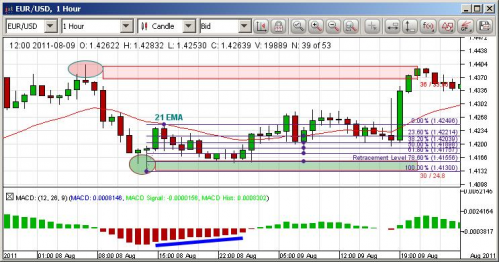
As a discretionary trader, using Fibonacci retracement ratios is my favorite
technique for identifying profit targets. Many books discuss using
Fibonacci as a trade entry technique, but I prefer to use them to identify
profit targets. Fibonacci ratios provide a simple and consistent profit management
IDENTIFYING PROFIT TARGETS

Knowing when to take profit on a trade is often a subjective and frustrating
process for many discretionary traders. Often a trade will be closed too
early or open too long while a trader tries to squeeze every last pip out
of it. Without a systemic, repeatable procedure to determine when to take
profits, a trader will never feel truly comfortable with his decision to take
profit, and volatility will continue to be an issue in his returns.
In this section you will learn two of my favorite tactics to identify profit
targets. First, you will learn how to use support and resistance to identify
simple profit targets based on price action. Second, you will learn an advanced
method of identifying profit targets using Fibonacci retracement
and extension ratios.
Identifying Profit Targets with Support and Resistance
COMMON PROFIT MANAGEMENT TECHNIQUES THAT INCREASE VOLATILITY

Regardless of how careful a trader is in planning a trade, there is no guarantee
that the market will reach the intended profit target. Occasionally
the market will come close to a profit target only to reverse direction and
move quickly against a trade. There is nothing more frustrating than setting
a trade in motion only to find out later that you could have taken a profit
but ended up with a loss.
Managing Profit

Complete trade management should include guidelines to enter a
trade, manage risk, and manage when to take profit. Many traders
focus on entering and managing risk but leave managing profit open
to subjective decision making, which is a mistake. Knowing when to take a
profit is important enough to include managing profit as a core trading principle
for bargain hunters. In this chapter you will learn to manage profit
KNOW WHEN TO TAKE A BREAK

Finally, the last mistake I see traders make on a regular basis is refusing
to take a break when their trading is really suffering. I think this applies to
discretionary traders more often than system traders. If you are a system
trader, you probably understand your trading system’s average drawdown
IS LOSING 70 PERCENT OF YOUR TRADES BAD?

What would you think if I told you I lost money on 70 percent of my trades?
Would you scoff at my trading performance? Would you think I’m a bad
trader? Or would you be interested in knowing how much I made on the 30
percent of trades on which I made money? Traders tend to focus on winning
and taking profits because nobody likes to lose money and everybody
BE CONSERVATIVE WITH TRAILING STOPS

To move or not to move my stop order—that is the question. Emotions are
a powerful thing to overcome when you are watching the market move
against a profitable trade. Many traders live by the advice “Never let a
winner turn into a loser,” and use trailing stop losses to protect profit
MANAGE RISK CONSISTENTLY

Since we are on the topic of position sizing and risk percentages, traders
often make the mistake of risking inconsistent amounts. Either they believe
in one trade more than another or they are just terrible at calculating
MANAGING RISK THROUGH POSITION SIZE

Managing risk is all about controlling the amount of money you lose when
a trade doesn’t go your way. Many traders make the mistake of sizing their
positions too large and losing more money than they should on a single
trade. To determine position size, you first need to decide how much money
STOP THINKING ABOUT LOSSES IN PIPS

Whenever I do a presentation about trading long-term charts, I’m always
asked how many pips I risk on each trade. Many traders assume that trading
a daily or weekly chart requires risking a tremendous number of pips
on each trade, and they can’t afford that risk. This is a logical assumption
because many traders are conditioned by lessons on day trading to risk
a small number of pips when trading a smaller timeframe. The notion is
REDUCING YOUR TRANSACTION COSTS

In terms of risk, another reason I promote long-term trading is to reduce
transaction costs. Currency dealers are very good at marketing the notion
that somehow the currency market is cheaper to trade because there are
BEWARE OF OVERTRADING

Without capital in your account, you’re dead as a trader; therefore, protecting
your trading capital should be your top priority. Anytime you open
a trade you are placing capital at risk, so it is important to select only the
ALWAYS USE A STOP ORDER

I get at least one e-mail each month from a trader who has let a bad trade
get away from him. Usually the trader did not place a stop order on his
trade and the market moved against him, creating a significant loss. Closing
Managing Risk

Losing is part of trading, and sooner or later you will lose money on
a trade. How you handle risk is the single most important concept a
trader must understand to survive long term. Unfortunately, managing
risk is a confusing topic for many traders. Through my blog I’ve spoken
with traders from around the world who have made the same mistakes I did
as an inexperienced trader; the discussions in this chapter are a response
to those conversations.
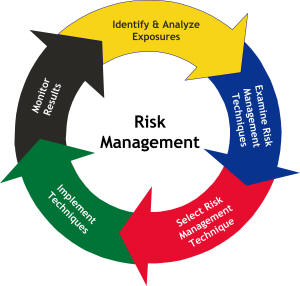
In this chapter you will learn how to use stop orders, avoid overtrading,
size your positions correctly, and manage trailing stops appropriately.
Managing risk is a key principle of bargain hunting because you can’t trade
if you end up losing all your money. Arm yourself with the information in
this chapter and you’ll be prepared to protect your account capital from
the risks of trading currency.
TRADING PRICE ACTION

Identifying support and resistance is only half the battle; to make money,
you have to be able to trade them. There are a couple of tactics I prefer to
trade price action along support and resistance levels, and you will learn
those tactics in this section. You will see these tactics in action when we
discuss actual trading methodologies in Chapters 6 through 9. To trade
Subscribe to:
Posts (Atom)